

In climate and nature finance, almost everything now seems to be called a bond: green bonds, blue bonds, sustainability-linked bonds, outcome bonds, impact bonds, catastrophe bonds, resilience bonds.
There is a reason for that. “Bond” carries weight. It signals scale, investor participation, legal structure, and capital-market credibility. It suggests that a problem has moved beyond grants, pilots, and policy ambition into the world of investable financial structures.
But the same word is now being used for instruments with very different mechanics, and the label can make them look more similar than they are.
Blue-labelled finance shows the problem especially clearly. Market guidance tries to anchor blue bonds in green-bond-style use-of-proceeds principles, but in practice “blue” is used across a wider range of structures, from corporate and sovereign borrowing to blue loans and labelled financing within debt conversions.
There is a cost to this label creep. When an outcome bond, a sustainability-linked bond, and a use-of-proceeds green bond are all grouped together as “bonds” on the same conference panel, the comparison can obscure more than it reveals. The language of capital markets can start to stand in for the harder discipline of repayment, risk allocation, and delivery design.
One word, several functions
In its simplest form, a bond is a borrowing instrument. An issuer raises money from investors and promises to repay principal, usually with interest, over time. Climate and nature finance has adapted that form in several distinct ways.
Green and blue bonds: use-of-proceeds borrowing. This is the most conventional meaning of a green or blue bond. The issuer raises capital and commits to allocate an equivalent amount to eligible activities. Under ICMA-style green bond principles, the issuer identifies eligible categories (e.g., renewable energy), explains how projects are selected, tracks or allocates proceeds, and reports on allocation and, where possible, impact. Blue bonds usually apply the same use-of-proceeds logic to ocean, water, or marine-related categories.
The Seychelles blue bond is a sovereign example: a small issuance that linked borrowing to a defined blue economy agenda, including sustainable fisheries and marine resource management. Xylem’s 2026 transaction is a corporate example: a $1 billion senior notes offering that included a $500 million blue-labelled tranche intended to finance or refinance eligible blue projects under its Blue and Green Finance Framework.
In both, the label shapes allocation and reporting. It does not mean the underlying environmental activity repays the bond. Investors are usually repaid from the issuer’s general repayment capacity: the sovereign balance sheet in one case and the corporate balance sheet in the other.
Sustainability-linked bonds: performance-linked borrowing. Sustainability-linked bonds sit here. Unlike use-of-proceeds bonds, they do not necessarily earmark capital for eligible projects. The issuer can usually use the proceeds for general purposes, while the financial terms are linked to performance against specified indicators.
In principle, this shifts attention from what money is spent on to whether the issuer meets defined targets. In practice, the quality of the instrument depends on the ambition of the target, the credibility of the baseline, the size of the coupon adjustment, and the consequences of underperformance.
Impact and outcome bonds: payment routing. This is where impact and outcome bonds sit. They borrow mainly from the social impact bond and development impact bond space, where “bond” has always been somewhat misleading. The structure is usually closer to a pay-for-success contract than a conventional capital-market bond: investors provide upfront working capital, service providers deliver an intervention, and an outcome payer repays investors if agreed results are achieved. Capital markets may be involved in some versions, but the central mechanism is the outcome-payment contract.
Nature and ocean impact bonds adapt this logic to ecological outcomes: fish biomass, community management, reef condition, biodiversity, carbon, restoration milestones, or other verified results.
Rare’s Small-Scale Fisheries Impact Bond in Indonesia fits this model. Investors provide upfront capital for community-led fisheries co-management, while outcome funders pay against agreed and verified ecological, governance, and livelihood results.
The Wildlife Conservation Bond, often called the Rhino Bond, is another version of this family. Investors purchased a World Bank bond linked to black rhino conservation in South Africa, but the proceeds went to the World Bank’s IBRD balance sheet rather than directly to conservation sites. The conservation link came through the return structure: investors gave up ordinary coupons, and their final return depended partly on verified rhino population growth, with outcome payments funded by the Global Environment Facility.
These examples show how a financial structure can organize capital around an ecological outcome, but the outcome becomes financeable because someone is willing and able to pay for it.
Debt conversions: refinancing plus conservation commitments. Debt conversions also route value toward conservation or climate commitments, but their central mechanism is refinancing. Existing sovereign debt is bought back, exchanged, or refinanced, often with credit enhancement from public or philanthropic actors. Some of the value created through the transaction is then routed toward conservation or climate commitments through trust funds, endowments, policy undertakings, or long-term payment schedules.
The Belize debt conversion in 2021 is a prominent example. The transaction combined a discounted buyback of existing debt, a Blue Loan to Belize, Blue Bonds issued through a repackaging vehicle, political risk insurance, a parametric resilience wrapper, marine conservation commitments, and a long-term conservation funding structure. The “blue” label captured the back-end financing, but the deeper architecture was about debt restructuring, credit enhancement, value distribution, and conservation governance.
Catastrophe bonds: risk transfer. Catastrophe bonds sit here. Investors are paid to take a defined layer of disaster risk. If the trigger is met, capital is released to the party seeking protection, usually through a special-purpose structure. If the trigger is not met, investors receive their principal back with interest.
This is a powerful tool when the exposure is well defined, the sponsor needs reliable liquidity after a severe event, and the risk layer is appropriate for capital markets. A sovereign, risk pool, insurer, or development institution can use a cat bond to pre-arrange financing to address the impacts of earthquakes, cyclones, floods, extreme precipitation, or other covered perils. Put differently, a cat bond can help manage fiscal volatility after a disaster, but it does not reduce the hazard, exposure, or vulnerability that generate the loss. That is why cat bonds should be read as part of disaster risk finance, not as evidence that capital markets are financing resilience in the broader sense.
Same label, different architecture
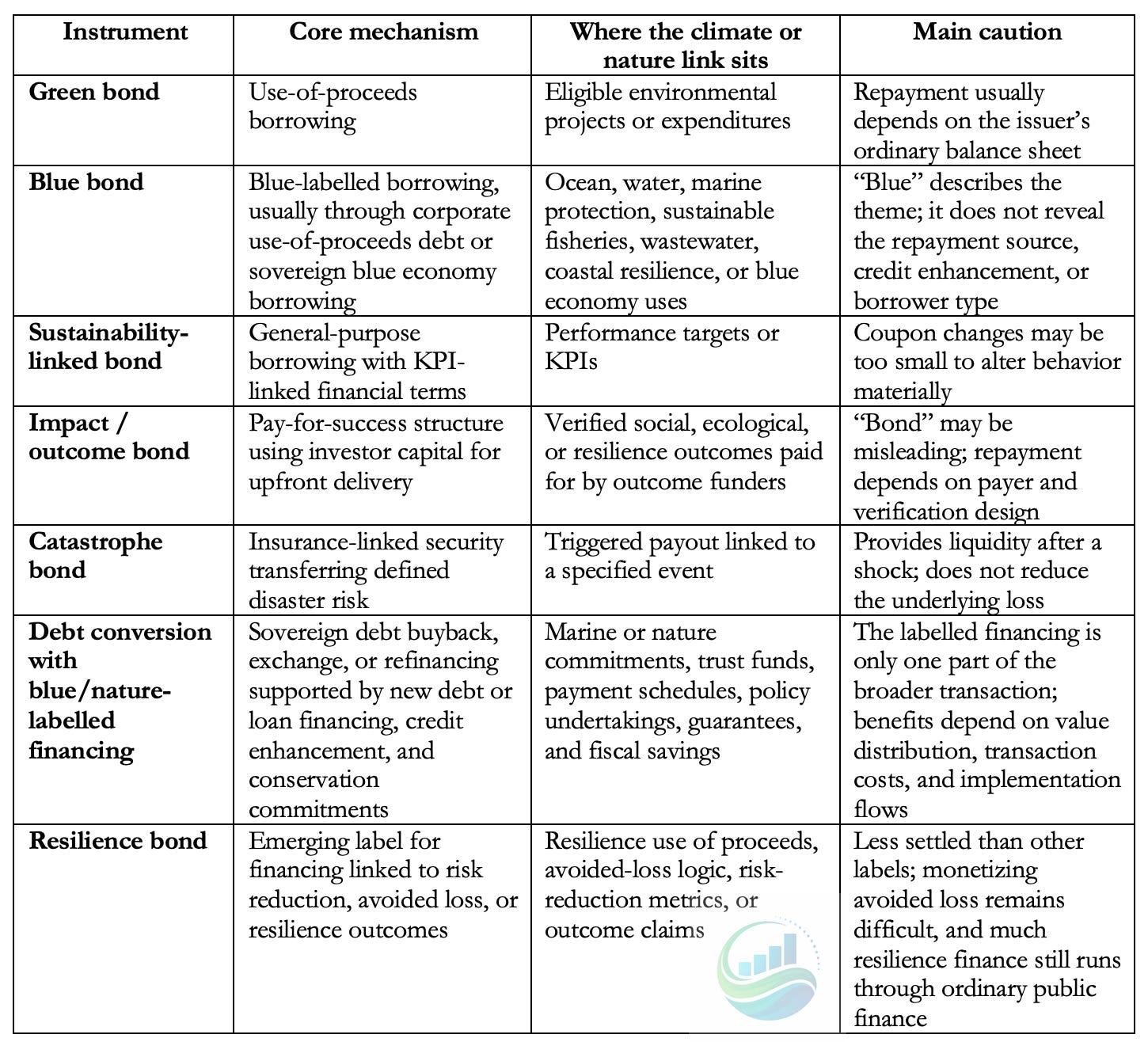
A simple taxonomy helps make the distinctions clearer. It also shows why some labels, especially “resilience bond,” remain difficult to pin down: they often describe an ambition to link risk reduction and finance rather than a single settled structure.
Value is not the same as investability
Nature and resilience finance often conflate value and investability. Resilience can avoid losses, reduce disruption, and protect public services. Nature can support water security, flood protection, carbon storage, food systems, tourism, fisheries, and health. But none of that value repays capital on its own. It has to be converted into an enforceable cash flow, such as a tariff, fee, premium, budget allocation, contractual payment, captured saving, or outcome payment. A bond can help organize that conversion. It cannot make it appear.
These instruments are therefore most useful as windows into the architecture around them. A use-of-proceeds bond reveals eligible expenditures and repayment capacity. A cat bond reveals modeled risk transfer pricing and post-event liquidity. An impact bond reveals who will pay for verified outcomes. A debt conversion reveals how refinancing, guarantees, and conservation commitments distribute value among creditors, sovereigns, intermediaries, and implementing institutions.
A practical reading test
Before treating any climate or nature bond as evidence of scalable finance, it helps to start with more basic questions.
Is it actually a bond? Some instruments are conventional debt securities. Others are insurance-linked securities, pay-for-success contracts, blended finance vehicles, refinancing packages, or project finance structures using “bond” language more loosely.
Are capital markets directly involved? A listed or privately placed security is different from a bilateral contract, donor-funded outcome agreement, or special-purpose structure.
What happens to the money raised? Does it finance projects directly, sit on an issuer’s balance sheet, refinance existing obligations, collateralize disaster risk, or provide working capital to an implementing organization?
What creates the climate or nature link? The link may come from use of proceeds, KPIs, a disaster trigger, conservation covenants, verified outcomes, carbon offtake, avoided-loss modeling, or reporting commitments.
Who pays whom, for what, and when? Repayment may come from taxpayers, ratepayers, corporate revenues, insurance premiums, MDB balance-sheet strength, donor-funded outcome payments, carbon revenues, or refinancing savings.
What risk has moved, if any? Some structures transfer catastrophe risk to investors. Some leave credit risk with the issuer. Some shift delivery risk to investors or implementing partners. Some mainly improve earmarking, reporting, or accountability.
Does the structure create a durable payment pathway? Some rely on recurring revenues or legal obligations. Others depend on concessional capital, donor support, reputational demand, outcome payments, or temporary credit enhancement.
The architecture beneath the label
Bonds will remain part of climate and nature finance. They can raise capital, impose reporting discipline, broaden investor participation, transfer defined risk, pre-arrange liquidity, refinance debt, and route payments toward outcomes that otherwise struggle to attract finance.
But a bond label is not a payment pathway. It does not create a payer, a revenue stream, or a risk reduction mechanism. Nor does it guarantee that the underlying activity can sustain repayment.
The decisive questions are practical: who pays, what they are paying for, how performance is verified, which risks have moved, and whether the payment pathway can survive beyond the transaction headline. That is where green, blue, nature, and resilience finance either become durable financial architecture – or remain labels attached to unresolved financing problems.
Ledger Notes
International Capital Market Association, International Finance Corporation, United Nations Environment Programme Finance Initiative, United Nations Global Compact and Asian Development Bank (2023). Bonds to Finance the Sustainable Blue Economy: A Practitioner’s Guide.
This guide tries to make blue bonds more legible by anchoring them in sustainable bond market practice and green-bond-style use-of-proceeds principles. It matters because the post argues that market guidance is trying to standardize blue bonds, while transaction practice remains more elastic.World Bank, Introducing the World’s First Sovereign Blue Bond: The Republic of Seychelles (2019) / World Bank press release, “Seychelles Launches World’s First Sovereign Blue Bond” (2018).
The Seychelles blue bond raised US$15 million to support sustainable marine and fisheries projects, with World Bank and GEF support. It is a useful sovereign use-of-proceeds example: the blue label shaped allocation and reporting, while repayment still depended on the sovereign financing structure and credit enhancement.Xylem, Blue and Green Finance Framework / Xylem Sustainable Finance materials (2026).
Xylem’s 2026 transaction included a US$500 million blue-labelled tranche within a US$1 billion senior notes offering, intended to finance or refinance eligible blue projects. It is a useful corporate use-of-proceeds example and a contrast with Seychelles: both are “blue,” but one is corporate balance-sheet debt and the other is sovereign borrowing.The Nature Conservancy (2022). Belize Blue Bonds for Ocean Conservation: Case Study – Belize Debt Conversion for Marine Conservation.
This case study explains the mechanics of the Belize transaction, including the debt buyback, Blue Loan, Blue Bonds issued through a repackaging vehicle, political risk insurance, parametric resilience wrapper, marine conservation commitments, and long-term conservation funding structure. It matters because it shows that the “blue” label can attach to back-end financing within a broader debt conversion, rather than describing a simple use-of-proceeds bond.